Tuesday, March 14, 2017

Harriet Jacobs and the Fight for Freedom

Lacy J. Rowan 
6th March, 2017 
American Literature 
Essay #2- Arguments about Slavery 

Harriet Jacobs and the Fight for Freedom 

In Frederick Douglass' speech “What to the Slave Is the Fourth of July?” he asks the question of who is entitled to liberty. I believe that Harriet Jacobs' "Incidents in the Life of a Slave Girl" answers the question of weather or not man is entitled to liberty though her own personal experience being a slave. 
Jacobs is able to provide a perspective of life as a slave by using pathos and personal stories told from her own perspective. She is able to describe how it feels to be both a free and owned person because she didn’t know she was a slave until she was six years old. She is also able to use pathos to make the reader empathize with her experience as a slave. Furthermore, she describes the dehumanization that occurred with the slavery. Slave owners viewed them as commodities rather than real people. She writes "These God-breathing machines are no more, in the sight of their masters, than the cotton they plant, or the horses they tend" (924). During this time period, a main argument for why slavery should not be abolished was that they were an economic system. Plantation owners made lots of money off of the work of slaves who would never receive a reward for their efforts, granted a decent place to sleep. The exploitation of slaves is an embarrassing mark on our history today, but at the time it was a highly debated topic. Jacobs' writing brings to light just how inhumanly slaves were treated and the hardships they went through. 
Jacobs writes about her personal experiences and how even the things we would see as an inherent right, were off limits to her. Because to add to the dehumanization of slaves, she was also not allowed to be with the man she loved. He was free but even if they were allowed to marry, he wouldn’t be able to legally claim her as his own. Not only did the law prevent them from being together, but the man who ran the plantation, Mr. Flint had taken a liking to Jacobs and often pursued her. At one point, he asked if she loved the man and when she responded yes, he said "I supposed you thought more of yourself; that you felt above the insults of such puppies" to which Jacobs responded "If he is a puppy I am a puppy, for we are both of the negro race. It is right and honorable for us to love each other" (926). Not only were slaves not treated as human, they weren't even referred to as human, only adding to the humiliation. Slave owners thought that slaves were not like caucasians, and therefore didn’t feel love like they did. A relationship between two slaves was seen as a commodity than a loving relationship. Mr. Flint suggested that she marry one of his slaves, to which she objected, showing that not even love is sacred in slavery. Not only did Jacobs not return Flint's feelings and grew to hate him, his wife, Mrs. Flint didn’t care much for Harriet Jacobs due to all the attention she was getting from her husband. Although Jacobs wasn’t allowed to marry her true love and she urged him to go to the free states and leave her behind, she held on to the hope that things may get better. There were ways to escape this horrific reality she was in, but none such methods have worked. Both her father and grandmother had tried frivolously to buy her. Jacobs write that her father's "strongest wish was to purchase his children" (922). To think that people had to purchase the children that they produced, is quite baffling. The fact that her father couldnt even buy his children, just shows how much they were treated as objects rather than people. Jacobs is able to illustrate that life as an African American was not a fair one at the time. Even though her father and grandmother worked hard to try and save her from a life of slavery, they still proved unsuccessful. They had tried to help give her a better life. But it was to no avail. Nevertheless, she tried to maintain a positive attitude and hope that there may come a day where her freedom is granted. 
While Harriet Jacobs was able to maintain a positive outlook considering her current situation, the effects of slavery and the treatment she received from others began to take its toll. Though Mr. Flint's relentless and seemingly endless pursuit of Jacobs, he tried to break down her spirits. To take that last spark of hope away from her. She writes "For years, my master had done his utmost to pollute my mind with foul images, and to destroy the pure principles inculcated by my grandmother, and the good mistress of my childhood" (929). Mr. Flint's attempts to corrupt Jacobs did not prove fruitless. Although she remained fairly positive and realized that she was better off than other slaves, she was still affected by the hardships of slavery. She writes "The influences of slavery had the same effect on me that they had on other young girls; they had made me prematurely knowing, concerning the evil ways of the world (929). Mr. Flint's relentless pursuits of Jacobs was an example of a bigger underlying problem. In this time, sexual assault was not only tolerated, but a benefit to a slaveholder. If a woman in his custody had a baby, that baby is a slave they don’t have to pay for. Another great example of the objectification of slaves. Perhaps the awareness of the evil in the world made her more likely to welcome the good. Shortly after her lover leaves to go to the free states, Jacobs begins conversing with another man. He knows her grandmother and is a free, white, unmarried man. Although Jacobs was only fifteen, he expressed great interest in her and wished to help her. Over time, they were able to converse more and more often and she began to fall for the man with whom she ended up having two children with while still in slavery. 
Although Jacobs' spirit was at times broken, she maintained her strength through her drive to protect her children. She was able to escape from the Flint plantation and hide in her grandmothers house. There was a narrow crawl space beneath the roof of her house and Jacobs remained there for a speculated seven years. While in the crawl space, she was able to overhear conversations being had of plans to capture escaped slaves as well as speculations about Jacobs' hiding location. She writes that it was mostly believed that she was in the free states and that no one suspected her grandmother's house. She was able to hear and see her children every one in a while, but could not so much as speak to them. They also didn't know where their mother was and Dr. Flint and his family often tried to bribe them for information they did not have about their mother. After several years, she learns that Dr. Flint is dead. Jacobs writes that she thought herself to be a better Christian saying that "I cannot say, with truth, that the news of my old masters death softened my feelings towards him. There are wrongs which even the grave does not bury. The man was odious to me while he lived, and his memory is odious to me now" (937). Even with the passing of Dr. Flint, Jacobs was not free, and although she held the resentment for him, she wanted nothing more than a life for her and her children. After some time, She is sold through a friend of her lover. She becomes a free woman from this sale, as do her children. She writes "A human being sold in the free city of New York! The bill of sale is on record, and future generations will learn from it that women were articles of traffic in New York, late in the nineteenth century of the Christian religion" (940). Even at the time of writing where she was free and slavery was not yet abolished, she predicted that one day it might be. That one day slavery will be a stain on American history and an unbelievable one at that. Fredrick Douglass' speech about who is entitled to freedom is supported by Harriet Jacobs' writing as it shows the lack of freedom, personal liberty, and objectification that the slaves experienced. 

Works Cited 
Incidents in the Life of a Slave Girl. 1861. The Norton Anthology of American Literature. Ed. Nina Baym and Robert S. Levine. Vol. B. New York: W.W. Norton, 2012. 920-42. Print. 


Friday, March 10, 2017


Brooke Zirker

Professor Lee

American Literature

4 March 2017

                                                            Blacks Rights to Liberty

Narrative of The Life of Frederick Douglass, An American Slave was first published in 1845. His first autobiography was so popular he actually ended up writing three different versions of his story. Frederick douglass begins his narrative by explaining how he is forced to separate  from his birth mother and that nobody will tell him when his birthday is. He tells the reader that it's very common for slaves not to know that much about their families or even themselves. Douglass works at Colonial Lloyds farm for the first part of his life, but eventually is sent on a ship to Baltimore to work for  Hugh Auld. while working for this ship carpenter he finds out that working in the city has many differences than working on a farm in the country. In baltimore, Hugh Auld’s wife started teaching him the letters in the alphabet but her husband immediately stopped these lessons. He was sent back Colonial Lloyds farm. This is when he actually understands what really means to be a slave. He is treated horribly and beaten very badly. He eventually escapes and settles down in massachusetts and marries a free black women. The narrative of Frederick Douglass argues that all men, even those of color deserve liberty.  through an appeal to emotion.

 When Frederick Douglass describes the beating and sexual harassment of several slave women in his narrative, he appeals to emotion to help argue that all men and women deserve liberty. At this point, Douglass is working for a different master named captain Anthony, a small-time slaveholder, and the first man that Douglass ever saw strip and beat a women. This experience was truly petrifying for Douglass. Throughout the narrative, Douglas writes about several instances where women were harassed and beaten. One experience that was especially damaging for Douglas the the beating of his aunt Hester. Hester, was caught disobeying direct orders from Captain Anthony by going out for the evening and spending the night with Ned Roberts. This Enraged captain Anthony, so he stripped her of her clothing, tied her up and whipped her senselessly ( Douglass 1184-1185). Douglas then describes it as,  “ … soon the warm, red blood ( amid heart-rending shrieks from her, and horrid oaths from him) came dripping to the floor” ( Douglass 1185). He explains that he was so frightened that he hid in the closet, and that he had never seen something so awful in his entire life ( Douglass 1185). When Douglass describing the effect of this event on his own life it helps others to see how slavery was really was back then. It is cruel, one-sided and incredibly gruesome. Slavery has not only physical effects but also mental/emotional effects on the slaves. I think part of reason that it was damaging for Douglass was the fact that he couldn’t help his aunt, he just had to sit there and watch it happen. These slaves were not able to defend themselves or have any control over this kind of situation. He uses these awful scenes to portray the cruel treatment by these slaveholders. These women didn’t deserve to be treated like this, to feel completely helpless, and this emotion that we feel for these women is just one of the many ways that Frederick Douglass argues that all slaves deserve liberty.

By describing the lack of knowledge and stability that Douglass had as a child, he draws sympathy from his readers to help argue that all men deserve liberty. At the very beginning of his narrative, Frederick Douglass explains that that he did not know when his birthday was and how he did not have any personal connection with his mother other than being biologically linked to her (Douglass 1182). A lot of slaves were torn away from their families and were never told anything about their situations. Frederick Douglass says “... it is the wish of most masters within my knowledge to keep their slaves thus ignorant” (Douglass 1182). These slaves didn’t have any information on themselves or their families, they were supposed to stay quiet, work, and obey all orders from their slaveholders. They were treated like objects. Douglass gets the reader's sympathy by explaining how these slaves, including Douglass, are kept from their families and are purposefully kept in the dark so that they will be easier to handle. When Frederick went to work for a ship carpenter named Hugh Auld his wife began teaching Douglass the alphabet and how to read. But her husband quickly stepped in and put an end to this saying, “If you give a nigger an inch, he will take an ell. A nigger should know nothing but to obey his master-to do as he is told to do. Learning would spoil the best nigger in the world” (Douglass 1196). This is another example of how Douglass was kept from learning and growing. By sharing these experiences he is showing how these slaves were treated and this draws sympathy from the reader. No man should ever be treated this way. No one should be derived of the opportunity to learn and have a family. But in order to have these things you have to be white. And Douglass uses these examples to show that all men should have these opportunities. 

When Douglass explains the irony of the way that the farm animals and slaves were treated in chapter three of his narrative, he draws compassion from the reader. He is sent to work for Colonel Lloyd who owned several slaves but was practically obsessed with his horses. Douglass says, “ The slightest inattention to these [horses] were unpardonable, and was visited upon those, under whose care was placed, with the severest punishment; no excuse could shield them…” ( Douglass 1189). So basically if the horses were not cared for, not fed or cleaned properly, or rubbed and groomed then the slaves would be whipped senselessly. Douglass shows that this slaveholder actually treats his animals better than he treats his human slaves. He uses this example to show his reader just how awful and emotional slavery really was. The fact that Colonial Lloyd treated his slaves like less than animals is actually a bit ironic, and I think Douglass uses this irony to show just how unfair the situation was. This causes this reader to have empathy and to feel for these people. Human beings shouldn’t be treated like this. Every man deserves to be fed, cleaned, and taken care of properly. Everyone deserves to be treated right and have freedom.

Frederick Douglass had a rough time growing up, not having a relationship with his family, being treated awfully and witnessing events no kid should ever have to witness. But he uses these truly unfortunate events to illustrate just how emotional and damaging slavery was. Nobody deserves to be beat, whipped and eternally punished for the color of their skin, they deserve to be treated with respect and have the right to liberty.


Works Cited 

Douglass, Frederick. Narrative of the Life of Frederick Douglass. The Norton Anthology of American Literature. 8th ed. Vol. B. New York: W. W. Norton, 2012. N. pag. Print.


Liberty Through Humanity


Liberty Through Humanity

            Harriet Jacobs, born in 1813 North Carolina, is best known for her tragic narrative, written under her pen name Linda Brent, Incidents in the Life of a Slave Girl. Jacobs tells the reader of her time spent as a slave, the time she hid from her slave owner, and the time she was finally granted the freedom she had longed for since she was six years old. Throughout her narrative, Jacobs shows the reader that slaves are human too, which means that they are deserving of individual liberty. Jacobs primarily shows the slaves’ right to liberty to the eighteenth-century reader through her use of pathos, showing the humanity of the slave through the atrocious things she faced during her time of captivity.

            Jacobs first shows this humanity through the telling of when she first realized she was a slave. Jacobs was born into a slave family, but her mother’s mistress was relatively kind to them (923). Jacobs was six when her mother passed away, causing her to be sold to another mistress who died when she was twelve, and then finally being sold to the daughter of the deplorable Dr. Flint (923). Jacobs started the chapter of her childhood saying, “I was born a slave; but I never knew it till six years of happy childhood had passed away” (921). Pathos has a strong presence in this sentence, because Jacobs is saying that as a child, she was blissfully unaware of the hardships she would have to face as a slave; she still had her childhood innocence until it was brutally ripped away when she was six and sold to another family. This portrayal of her loss of innocence hits the reader with the reality that slaves were human too, having been born with childhood innocence, same as white children, that the slave holders took away. Through this display, Jacobs proves that slaves are human and if they are human, then they deserve the same liberty as everyone else.

            Another instance in Incidents in the Life of a Slave Girl showing the humanity of slaves, is the time when Jacobs fell in love. Jacobs falls in love with a free man, a carpenter, who wanted to purchase her from Dr. Flint’s daughter so that they could get married and live a free life (924). When Jacobs approaches Dr. Flint with the proposal, Dr. Flint refuses to sell her—and refuses to let her get married. Dr. Flint is enraged when she tells him she is in love, and tells her that the only time she is allowed to be married is if it were to one of his slaves, which would keep her in his sights for the rest of her life (925). The humanity of slaves is shown by the fact that Jacobs fell in love and wanted to get married, the same as any white man or woman would have wanted to do. She shows that slaves can fall in love and have dreams of having a family, and would do so if it weren’t for the fact that they were hesitant of having such relations when they were literally owned by another white family. Jacobs asked, “Why does the slave ever love?” because if slaves fell in love, they had to fear so many more things, like having children born into slavery, which is something parents would never wish on their children (924).  Jacobs shows that slaves shouldn’t have to worry about things such as that, because they are human and should have the liberty to do these things because of the fact that they are human.

            Jacobs also showed the humanity of a slave through her desperation to get out of the household of Dr. Flint and his wife, and her sudden urge to get revenge upon Dr. Flint. Dr. Flint was constantly watching Jacobs with malicious intent. She was always aware of the sexual thoughts he held in regards to her. He was also abusive towards her, and those two combined were hard for Jacobs to endure. Couple those with the fact that because of his lust for Jacobs, Dr. Flint’s wife hated her and abused her as well, Jacobs came to the point that she was so desperate that she would do anything to get away from the Flint family, and that desperation soon turned into a want for revenge. She took action when meeting a young, unmarried white man, that made his interest for her obvious (929). She used this interest and ended up getting pregnant with this man’s children, thinking that there was no worse revenge against Dr. Flint than showing him that she favored another over him (930). These feelings are the ultimate display of humanity. Jacobs says, “The influences of slavery had had the same effect on me that they had on other young girls; they had made me prematurely knowing, concerning the evil ways of the world. I knew what I did, and I did it with deliberate calculation” (929). She is effectively showing the reader that she had been changed by the violent system that she belonged to, which turned her to making the desperately human choices that she made. Showing these unmistakably human choices, she is proving to the reader that slaves are humans, and deserve the liberty that the white people had.

            When Jacobs was finally granted the freedom that she had been wishing for her whole life, she used her experiences to show the eighteenth-century reader the horrors of the slave system. Her powerful narrative gives insight into the treatment that slaves received, and the liberties that were taken from them when they were in captivity. Incidents in the Life of a Slave Girl is full of emotional scenes that depict the humanity of the slaves. Jacobs shows that slaves have the right to the liberties that have been taken from them, because of the fact that they are human and liberty is a human right.


Works Cited

Jacobs, Harriet. Incidents in the Life of a Slave Girl. The Norton Anthology of American Literature.         8th ed. Vol. B. New York: W. W. Norton, 2012. N. 920-942. Print.

Thursday, March 9, 2017

Harriet Jacobs’ Argument for Liberty

Harriet Jacobs’ Incidents in the Life of a Slave Girl was published in 1861 under the pseudonym Linda Brent. This piece of work is an autobiography of none other than Harriet Jacobs who was actually the first known African American woman to author a slave narrative in the United States. In the book, Jacobs narrates the life in which she lived while she was under slavery from birth till 1852. Jacobs describes times in her life when slavery treated her “well” by it’s standards and also times when slavery tore her apart inside. She was around 37 years old when she finally received her and her children’s freedom in 1852. Jacobs argues that slaves are entitled to their own liberty because slavery demoralizes women, deprives them of their right to make a family home, and takes away their natural birthright of liberty.
Jacobs argues that the demoralization of women in the system of slavery is just cause to give slaves their liberty. Throughout her narrative, Jacobs continuously veers her argument towards white women in the North whenever mentioning her hardships as a woman. She does this in order to “create sympathy for her plight” and to “win the respect and admiration of her readers” for the courage and independence that she shows (Baym and Levine 921). One example of her directly addressing white women in the North is when she compares the rights that they have versus the rights that slave women have as she says “But, O, ye happy women, whose purity has been sheltered from childhood, who have been free to choose the objects of your affection, whose homes are protected by law” (Jacobs 929). She goes on to say “If slavery had been abolished, I, also could have married the man of my choice; I could have had a home shielded by the laws…but all my prospects have been blighted by slavery” (Jacobs 929). When she makes this comparison she is playing with the emotions of the white women in the North in order to show them that their value of the fragile and gentle persona of a woman is being demolished by slavery. In Jacobs narrative, she is denied the right to marry her first love, is sexually harassed by her white master, and is so desperate to escape slavery that she sacrifices her own purity in a tactful plan to be sold from her master to her unborn child’s father. Jacobs is forcing these women to visualize life as a woman in slavery without all of the virtues that are most important to women.
In Jacobs narrative, she puts an emphasis on the fact that slaves should have the liberty to create their own family home. While Jacobs was growing up she had the privilege of being raised in a household in which “her parents were allowed to live together even though they had different masters” (Baym and Levine 920). Since Jacobs was blessed to experience this sense of a family home, she was never aware of her condition of being a slave until she was six years old when her mother had died (Jacobs 923). As she got older she realized that the sense of family she had experienced was not common amongst slavery. Her own grandmother suffered the loss of one of her sons as “her children were divided among her master’s children” and “Benjamin, the youngest one, was sold” (Jacobs 922). Not only were families being separated, but mothers nursing their mistress’ children along with their own children would have to wean their baby at a very early age so “that the babe of the mistress might obtain sufficient food” (Jacobs 923). In Jacobs’ experiences with her own family of her and her two children, she feared for their future as slaves knowing of her inability to protect them from their masters. After the birth of her first child, her master threatened to sell the baby and Jacobs expresses her distraught by saying “his threat lacerated my heart. I knew the law gave him the power to fulfill it” (Jacobs 932). This would be particulary disturbing to readers at the time because of the belief that family was one of the most important virtues and should be kept sacred and protected.
Jacobs argues that slaves should have liberty because she believes they were born with a natural right to it. She doesn't view the issue of liberty as something that slaves have to gain; she views it as something that has been stolen from them and needs to be taken back. Throughout Jacobs’ entire narrative she continuously remarks claims to her own liberty and others to theirs. She talks back to her master’s threats by saying “‘You have tried to kill me, and I wish you had; but you have no right to do as you like with me’” (Jacobs 926). In doing this, she is consciously putting herself in danger from her master just because she has such a strong pride and belief in her right to liberty. She also fights back against her master’s views of her request to marry a freed black man by saying “‘Don't you suppose, sir, that a slave can have some preference about marrying? Do you suppose that all men are alike to her?’” (Jacobs 925). When Jacobs gives this response she is fighting back the notion that another person has the right to control her life and who she marries. To Jacobs, only she has the right to decide that for herself. When her mistress’ husband came looking for Jacobs after she ran away to the North, she sent a close friend to contact them and discover their intentions. Her friend replied to the husband’s offer to have her buy her freedom by saying “‘I have heard her say she would go to the ends of the earth, rather than pay any man or woman for her freedom, because she thinks she has a right to it’” (Jacobs 939). This sort of attitude from Jacobs is not surprising and is a direct example of how she believes that everyone has a right to their own liberty. Jacobs ends up having her freedom bought by a close friend who cared about her deeply, only wanting freedom for her beloved friend and nothing else. Even though Jacobs objected having her freedom bought at first, she says “I am deeply grateful to the generous friend who procured it, but I despise the miscreant who demanded payment for what never rightfully belonged to him or his” (Jacobs 940). Once again, Jacobs expresses the birthright of liberty and freedom that everyone should have.
Jacobs would not necessarily be considered a subtle woman when it comes to the right of liberty. Throughout her narrative she's said time and time again that liberty is not earned or gained; liberty is a natural right that everyone has a claim to and only they can claim their own freedom. She's showcased the issues of slavery that would mean the most to white women in the North in order to evoke a feeling of sympathy towards slave women and hopefully a feeling of despisement towards slavery. Jacobs sacrificed a lot in her lifetime, including a proper family experience, but the act of putting all of her most shameful life moments on paper and into the public has to be one of her biggest sacrifices. She didn't do it for any other reason than to work towards the end of slavery and the achievement of liberty for all. In doing this, she showcased her biggest argument that slaves should have their own liberty.


Works Cited
Jacobs, Harriet. From Incidents in the Life of a Slave Girl. The Norton Anthology of American Literature. 8th ed. Vol. B. New York: W. W. Norton, 2012. N. pag. Print.


Baym, Nina, and Robert S. Levine, eds. "Harriet Jacobs." The Norton Anthology of American Literature. 8th ed. Vol. B. New York: W. W. Norton, 2012. N. pag. Print.

Wednesday, March 8, 2017

Edgar Allan Poe: The Tell-Tale Heart

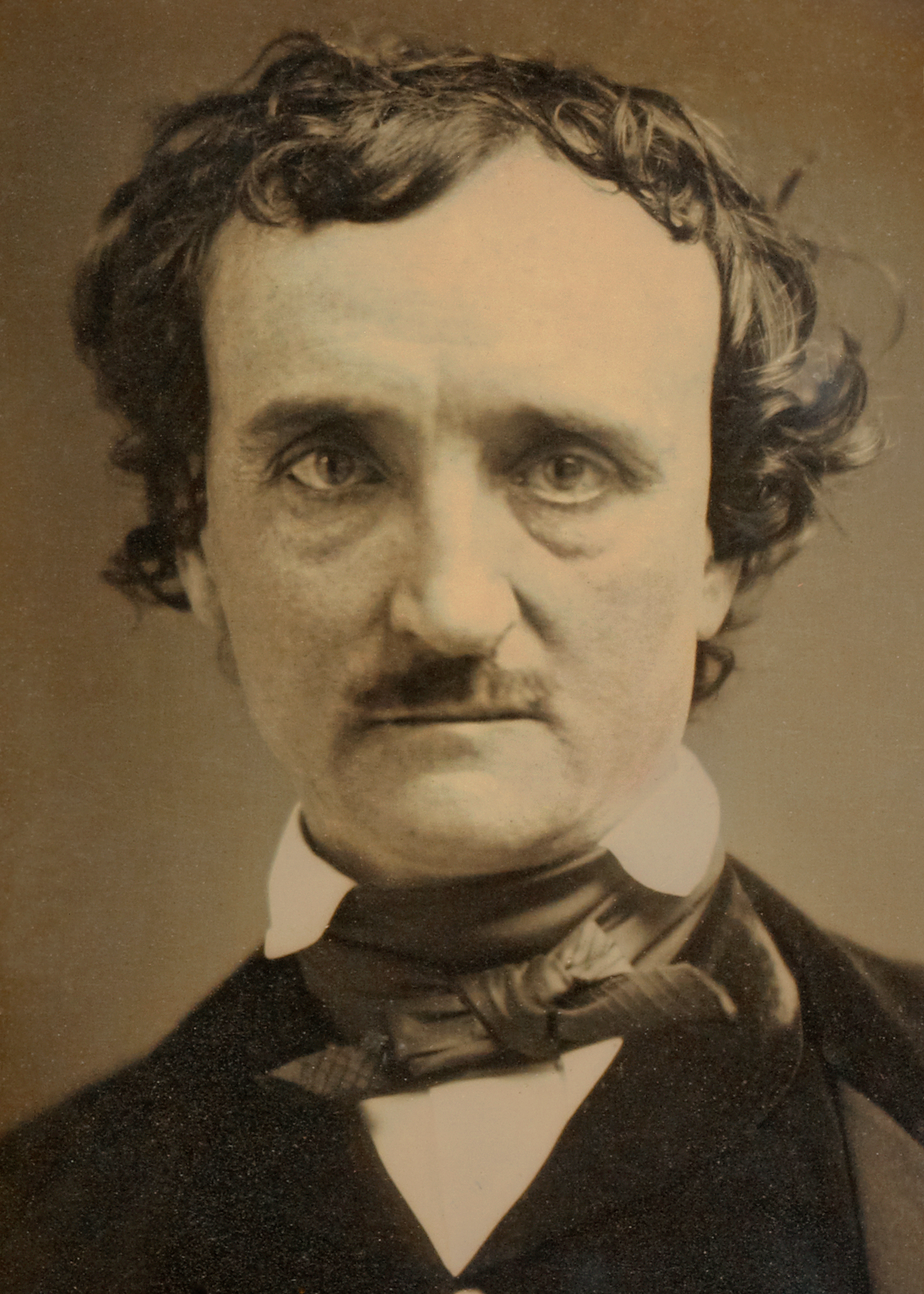
Edgar_Allan_Poe_daguerreotype_crop.png
Edgar Allan Poe was born in Boston on January 19, 1809 and lived to be one of the major American writers of his generation. Poe’s parents were both actors and died by the time he was three years old. He went on to be raised by John and Frances Allan, a couple with no children living in Richmond, while his two other siblings were sent to different foster parents. Poe attended good schools in England until Allan’s business prospects dwindled, forcing them to move back to Richmond. This is when tensions started to arise between Poe and his foster father which ended in Allan refusing to pay for Poe’s school and Poe ending up in debt from gambling. Allan later ordered Poe out of his house when Poe was eighteen years old. Poe eventually married his cousin, Virginia, in 1835 when he was 27 and she was 13. Throughout his life Poe had always struggled with substance abuse and alcoholism, especially after his wife died in 1847 from Tuberculosis. Among Poe’s accomplishments, he invented the modern detective story in 1841 with his The Murders in the Rue Morgue. This went on to inspire many other detective writers like Sherlock Holmes to further explore detective stories in their own works. He eventually died in Baltimore in 1849 under mysterious circumstances. His story, “The Tell-Tale heart”, is seen as a classic in the Gothic genre to many people and is actually one of his most famous short stories.
peeping door tell tale heart.jpg
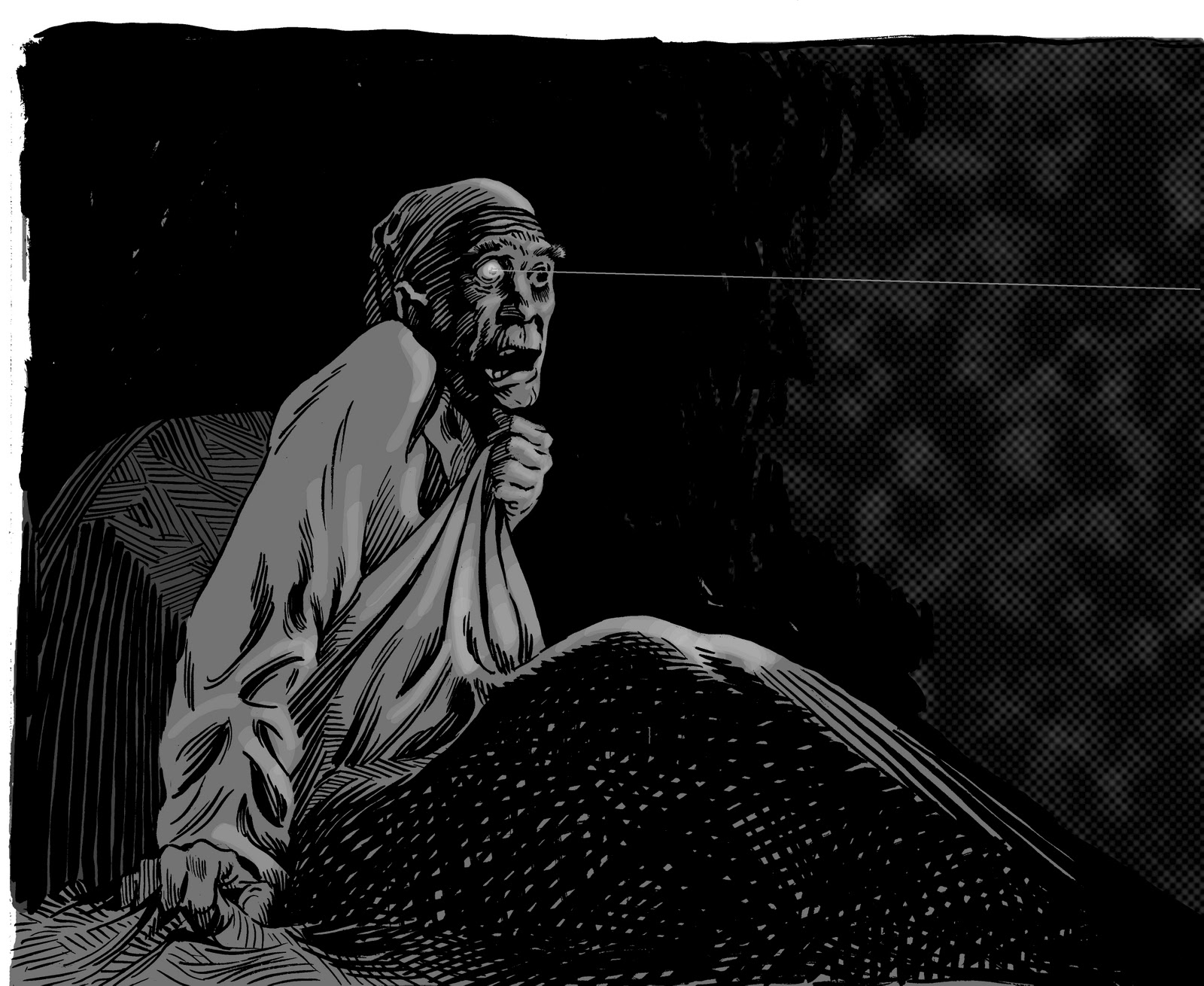
“The Tell-Tale Heart” is told by an unknown narrative figure who suffers from a sort of psychological paranoia. He starts talking about his decision to kill an old man because this man had a pale blue eye which the narrator described as “the eye of a vulture” (691). Throughout the whole story he argues his sanity as he shares his motive to kill. He states that he did not want to kill the old man because of any other reason than his vulture eye. For seven days, he went into the room of the old man at around midnight each night, opened the door cautiously, and struck a “single thin ray” of light from a lantern upon the old man’s vulture eye (692). However every night when he did this the man’s eye was closed shut, preventing the narrator from killing him right then and there. Throughout this process, the narrator makes a point to showcase his cunning and wise actions towards creeping in and out of the man’s room. He shows this very plainly when he says “You should have seen how wisely I proceeded-with what caution- with what foresight- with what dissimulation I went to work” (692). As he visited the old man in his room on the eighth night his thumb slipped as he was opening the lantern, causing the old man to become startled as he “sprang up in the bed, crying out- ‘who's there?’” (692). When the narrator shines the thin ray of light unto the man’s vulture eye he finds it to be wide open. This infuriates him and fuels his desire to murder the man. He starts hearing what he presumes to be the old man’s heart beating faster and louder every second and worries that the neighbors might hear it (693). He then “leaped into the room” and dragged the old man to the floor, killing him (693). He rid of the man’s body by dismembering the corpse and hiding the pieces underneath the floor of the man’s room (694). After he was done three police officers came knocking at the door because of a reported shriek from the house (694). As the narrator was showing the officers the old man’s room he began hearing the sound of the man’s heartbeat once again growing louder and louder and thought the officers might hear it. This caused him to abruptly confess the crime of murdering the old man to the three officers.
Illustration for The Tell Tale Heart.jpg
Poe’s “The Tell-Tale Heart” is the shortest story that he wrote and he used very short sentences in order to provide a sense of urgency and suspense for his readers. The unknown narrative voice in this story suffers from paranoia and believes that the side affects of his psychological disease are actually what makes him wise and cunning.  Throughout the story the narrative voice is talking about the incident as if it had already happened and judging by the ending of the story, he is talking to some sort of authoritative figure. He does not hate the man, he only hates the man’s eye. He makes a point to distinguish between the two in order to put the blame of the murder on the eye and all of its tempt for murder. The narrator perceives the sound of a heartbeat growing louder and faster as the old man’s heart when in fact, it was his own heart. Poe uses this as a way to show that the murderer was feeling nervous and guilty beyond belief. His own conscious guilt was represented by his heartbeat and he tries to get rid of it by assigning the loud heartbeat to the old man instead while he abandons his own humanity. In this story, Poe is playing with the psychological mystery of why people sometimes harm their loved ones.
I also found this great website here https://www.poemuseum.org/ that includes extra information about Poe’s biography, all of his works, and the museum that was erected in his honor in Richmond, Virginia. The museum is home to the largest collection of Poe memorabilia in the world!
Works Cited
Baym, Nina, and Robert S. Levine, eds. "Edgar Allan Poe." The Norton Anthology of American Literature. 8th ed. Vol. B. New York: W. W. Norton, 2012. N. pag. Print.
Poe, Edgar Allan. "The Tell-Tale Heart." The Norton Anthology of American Literature. 8th ed. Vol. B. New York: W. W. Norton, 2012. N. pag. Print.